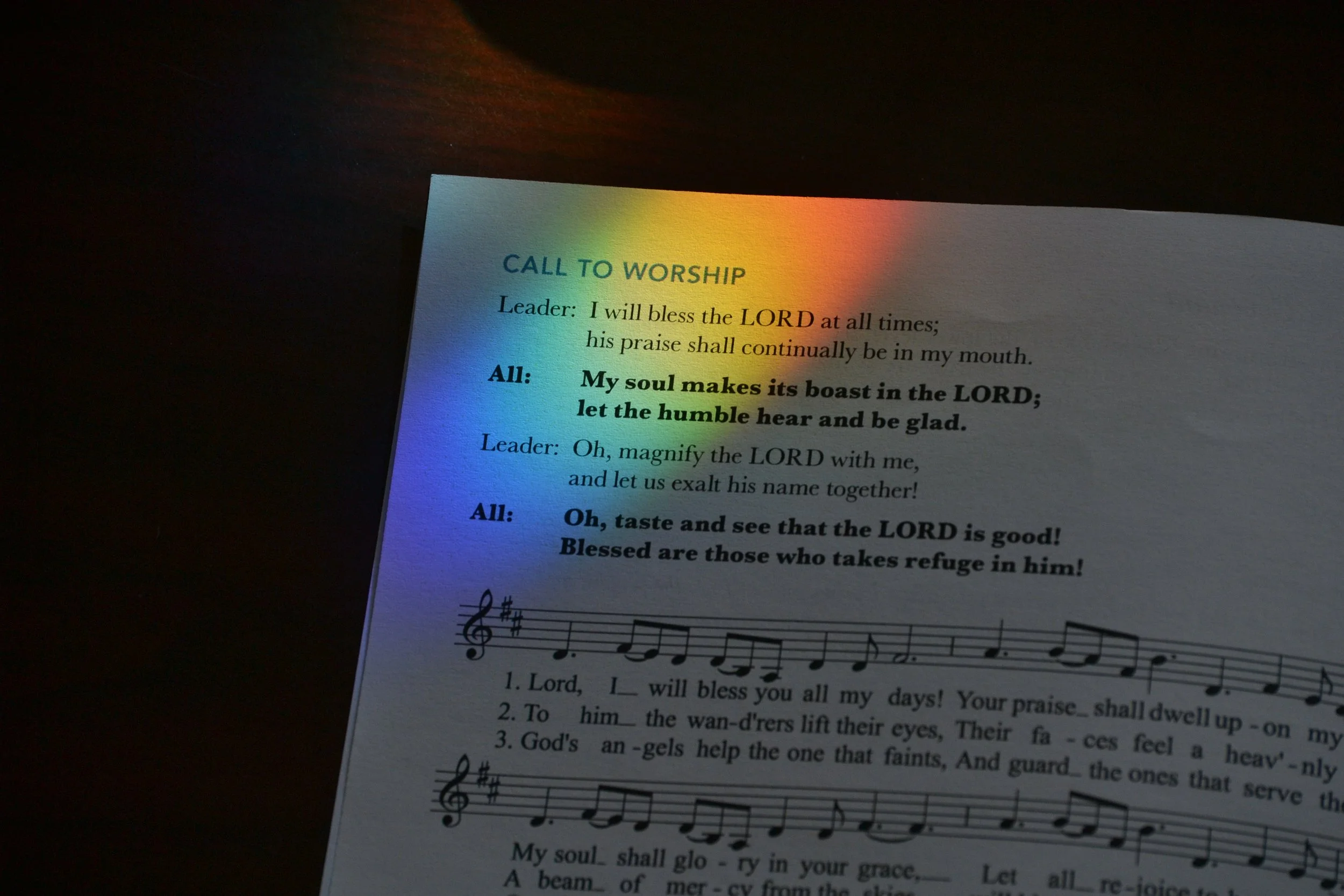
Photo credit: Renee Rumbley
Read part 1 of this article here
The Bible begins with God’s intrinsic creative nature (Gen. 1). We are created in the image of a creative God (Gen. 1:26). Our cultural mandate is to cultivate and care for all God has created for us (Gen. 1:28). Unable to create from nothing, we work with what God has given us (Gen. 1:29). Our creative work is to take part in caring for and cultivating the earth (Gen. 2:15). Sin let entropy into the created order and therefore God’s creation must be constantly revived (Gen. 4:6). God establishes this motif by communicating lasting meaning through symbolic creative beauty (Gen. 9:13–16).
We have been entrusted with this divine creation and creativity (Ps. 8:6). Our innate expressions of this creativity are revealed throughout Scripture in expansive mediums—from music (Gen. 4:21) to fine metalworking (Gen. 4:22). Our work is commissioned to have meaning beyond its utility (Ex. 28). These creative media expressions and their meanings are naturally shared and used to guide others (Ex. 15:20). This creativity and skill is not merely of our own nature as image-bearers, but may be amplified by the Holy Spirit to accomplish God’s design (Ex. 35:30–35). We also mediate our human, and often broken, experiences within our cultural forms (1 Sam. 18:6–7). Our craftsmanship and architecture matter because of what it communicates (1 Chron. 17, 22).
We are instructed to sing to God (1 Chron. 16:23, Jer. 20:13). Our most primeval and universal medium, music is at the center of key moments in life throughout the narrative of God’s people: in meaningful relationships (Gen. 31:27, Luke 15:25); within significant ceremonies (2 Sam. 15:10, 1 Kings 1:39); in public celebrations (2 Sam. 6:5); to comfort and push back the darkness (1 Sam. 16:23); even when our songs become corrupted in our fallenness (Ex. 32:17–19). Jesus, Our Savior, sings intentionally with his community (Matt. 26:30, Mark 14:26). Likewise, His followers return the gift of song to God and in doing so minister to others (Acts 16:25).
We follow the one who is God perfectly imaged in our human context: Yeshua the Nazarene; Jesus of the Bible; the medium and the message of God (John 1:1–18). The Son of Man is introduced to us as the son of David (Matt. 1). Beyond shepherd or ruler (1 Sam. 17:34, 2 Sam. 5), the progenitor of our Savior was an author, songwriter, poet, and musician (1 Sam. 16:15–18, 2 Sam. 23).
Great communicators and artists populate the Bible as central characters: Isaiah was a poetic historian and creative orator (2 Chron. 32:32, Isa. 6:6–8); Solomon was a brilliant poet, songwriter, and writer of wisdom (1 Kings 4:29–34); The writer of Job applied the styles of a play, a novel, and of poetry (Job 3:1–27:23, Job 1:1–2:13, Job 38:1–42:6); Jeremiah lamented in poetry and prophetic drama (Jer. 8:18–9:6); Ezekiel and Hosea were creative orators and engaged prophetic drama (Ezek. 3:16–19, Ezek. 7, Hos. 1); Most-all the minor prophets wrote poetry (Joel 1–3, Amos 1–2, Obad. 1, Mic. 1, Nah. 1, Hab. 1, Zeph. 1); Jonah chose short story and poetry to tell his tale (Jonah 1:1–2, Jonah 2:2–9).
When we consider that two-thirds of the New Testament is a quote or direct reference to the Old Testament and half of those references are from the Psalms—which are songs, poetry, and creative expression—it is clear that these forms were vitally important for the Apostles’ self–understanding and critical for their worship and life of devoted obedience to Jesus. As such, the New Testament cannot be separated from the meaning rooted in the soil of the Psalms. Clearly, the New Testament writers saw themselves as living the drama of the Psalter, now brought to a stunning conclusion given incredible and unforeseen depth of meaning in the person of Jesus.
Throughout the New Testament, the people of God respond in poetry and song. Significantly, Luke records Mary’s Magnificat (Luke 1: 46–56) in our introduction to the incarnation of Jesus. The mother of Jesus performs her own sung words in response to the blessing bestowed upon her. A poetic verbalization of praise as a worshipful and prophetic reaction directly linking the history and character of God to the incarnation of God through her in Jesus Christ. Her specific words are a radical cultural expression in any context. We see again that the meanings embedded in lyric, poetry, and the medium of song are a central way that those living within the unfolding of the incarnation could express themselves and interpret their experience as part of the ongoing drama of God’s activity in the world. Likewise, remembrance and community in common song, expressed in corporate singing to God, and grounded in the Psalms, is a natural and expected practice (Rom. 15:9, 1 Cor. 14:15, Eph. 5:19, Col. 3:16, James 5:13, Rev. 5:9).
The gospel itself means “Good News” which is a story to be communicated to all who will hear (Mark 16:15). The New Testament writers took up the spoken and written word in a multitude of forms: Matthew wrote a narrative that changed him as he composed it[8]; Mark wrote in memoir of Peter’s self-denouncement (Matt. 26:69–75)[9]; Luke wrote a two-part biography; John wrote a creative non-fiction version of the gospel from the intimate understanding he shared with Jesus himself [10]; Paul wrote beautiful, poetic and elucidating letters; The writer of Hebrews wove the testaments together in creative grandeur, showing that Jesus is supreme over all; John wrote the illustrative, epic, dramatic finale to the canon—an apocalyptic revealing through language that situates us in time and space as we learn to hope for eternity.
Ever the craftsman, Jesus blended imagination, illustration, and style into his life and teaching at every turn. Resulting in the most meaningful, memorable, and transformative ministry messages, parables, and movements ever crafted. Yeshua from Nazareth was certainly a skilled, meaningful communicator. Ultimately, at the center of the cross of our salvation, at the height of Jesus’s suffering, at the moment Christ bore the full weight of our sin, simple lyrics of lament from Psalm 22:1 were cried out (Matt. 27:46), “My God, my God, why have you forsaken me?” That Jesus chose a lyric from the songs of David for this moment of ultimate pain should be enough to reassure us of the importance of media that ministers.
“Christ clearly calls his church to communicate as light to the world, and that must include what we create with media. ”
The Light of the world (John 8:12) images forth His radiant purpose through His body, the Church. By extension, Christ followers are the light of the world (Matt. 5:14). Not should be or could be a light to the world—Are! We cannot be hidden. We communicate something no matter what, and we are to be seen. Christ clearly calls his church to communicate as light to the world, and that must include what we create with media. Our media are extensions of our very selves. Visual media is literally light. Media is a central part of any “city” ecosystem. Global connectivity is the highest of “hills.” The forms we shape this light into matter deeply and were meant to be used to make a difference in the world.
Stay tuned for the 3rd and final part of this article!
[8] Eugen Rosenstock-Huessy, The Fruit of Lips: Of Why Four Gospels? (Wipf and Stock Publishers, 1978), 23. Eugen is referencing the perspective difference evident between Matthew 1:1, 21, and the way he writes in chapter 28.
[9] Ibid., 33–34.
[10] Ibid., 35.